

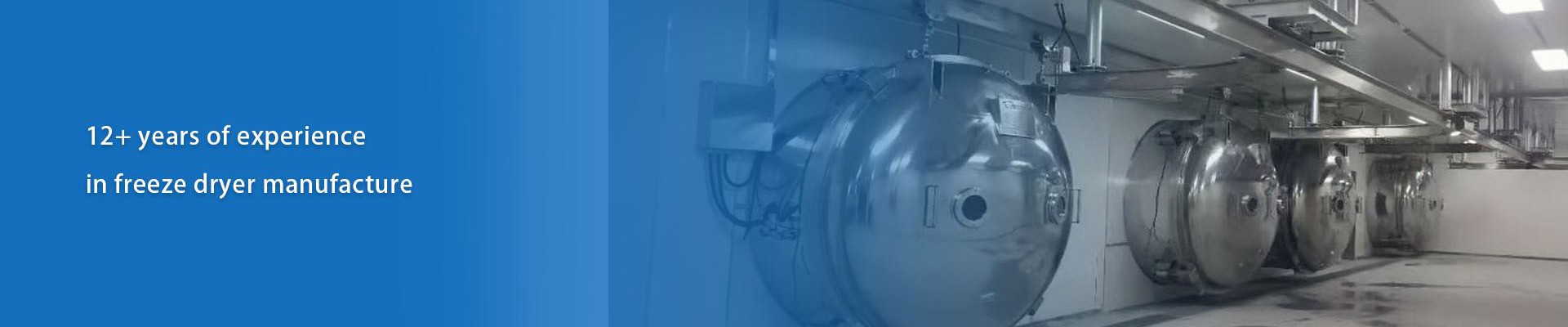
凍結乾燥機メーカーは、材料の凍結乾燥に影響を与える主要なパラメーターを分類しました。これには、主に4:共晶温度、共晶温度、崩壊温度、ガラス転移温度が含まれます。
The eutectic temperature refers to the temperature at which the moisture in the material is completely frozen into ice crystals. The principle of vacuum freeze-drying technology is the process of directly sublimating water from a solid state to a gaseous state without going through the liquid state. In this process, only two phases are transformed, that is, the solid state is converted into a gaseous state.
If the material is not completely frozen and some liquid material is retained during the freeze-drying and pre-freezing process, the phenomenon of "bubbling" will occur in the sublimation drying stage, that is, the boiling phenomenon of the liquid material under low pressure. The material is reconstituted again, the internal structure is not uniform, and some materials are sticky, which eventually leads to poor resolubility of the product. Therefore, in the pre-freezing stage, the temperature should be lowered below the eutectic temperature, and the moisture in the material should be completely frozen into ice crystals without the existence of liquid materials.

共晶温度は共晶点とも呼ばれます。 水は固定された融点を持っていますが、溶液はそうではありません。 凍結後の溶液は通常、一定の温度では溶けませんが、温度が徐々に上昇するにつれて、結晶の量は徐々に減少します。 、最終的な固体が完全に溶けるまで。 溶融が始まるときに液体が現れる温度は、融点と呼ばれます。 溶液の場合、これは溶質と溶媒の一般的な融点です。 この温度は共晶温度と呼ばれます。
崩壊温度は、崩壊温度とも呼ばれ、一部の凍結-乾燥材料の場合です。 凍結乾燥材料の温度が徐々に上昇すると、その剛性は徐々に低下します。 温度が特定の臨界値に達すると、その剛性は材料の3次元構造を維持するのに十分ではなく、材料が崩壊し始めます。 この臨界温度は材料と呼ばれます。 崩壊温度。
ガラス転移温度とは、材料の最大凍結濃縮物のガラス転移温度を指します。 材料の配合に加えて、ガラス転移温度は、構造、凍結前の温度、および材料の速度にも密接に関係しています。


